
May 14, 2026 Winter 2026
 Screenshot of the final zoom call of the Wednesday section of Narrative Constellations. 16 people pose for a photo, most of them are smiling, several of them are making peace signs and hearts with their hands.
  Screenshot of the Sunday section of Narrative Constellations, after sharing our final projects with each other! A screenshot of a Zoom call featuring 12 people of diverse racial and gender presentations smiling and holding up peace signs or hearts.
Narrative Constellations was a ten-week class in Winter 2026 taught by April Soetarman with assistant teachers Lee Beckwith and Cameron Granger. As we (Cameron and Lee) thought about what aspects of the class we wanted to share with a wider audience, we realized that we didn't even know what had happened in each other's sections! While each section was engaging with the same material, prompts, and projects, the conversations, resources, tangents, and energy that emerged in each section was unique. We realized that we were both very curious about each other's sections, and wanted to invite readers into our reflective sharing process. What follows is a transcript of our conversation about our parallel experiences this winter, lightly edited for clarity and cohesion.
Lee: So what drew you to this class?
Cameron: Well, SFPC reached out and said, “Hi, April needs someone that is familiar with Twine to co-AT this class. And I was like, yeah, I've used Twine before. I could do that.”
They both laugh.
C: But for real though, I met April at an event SFPC did at the Museum of the Moving Image last summer. We were each talking about the classes we were teaching at the time. We were all doing some like game-adjacent courses. She was talking about Narrative Constellations, and I really liked the way that she was thinking about narrative design. And it seemed like the course had this very warm, vibrant energy to it. I was like, oh, I think I like this person. I think working with them would be cool.
C: How did you and April link up for the first class then?
L: Yeah, similar to you, SFPC reached out to me and I had used Twine only once before. I'd actually used it for another SFPC class that was taught by Kameelah Janan Rasheed, and I made a little hypertext thing. That was my first time ever using Twine. I think I just heard about it through the internet somehow, and I had a lot of fun with it. I got a very brief description of the class, but I was like, “This sounds cool.” Non-linear storytelling, I'm so into that. I love thinking about time. I think there is something pretty universal about this class, even if you're not super into, you know, the the Twine of it all.
C: Yeah, exactly. I think for me it was so exciting, because I'm definitely more like a video game guy, like that's where my knowledge of interactivity comes from. But we had a lot of students who were into tabletop RPGs, and not just like D&D, but a lot of solo role-playing games too. And you know, April talks about a lot of different ARG games and sort of more immersive performance-type things. That was all really new and very exciting for me, to just learn a bit more about that world. Seeing all these different ways that play can fold into your life felt very generative for me.
L: Even though of course the class happens online on a screen, I think so much of the work that people made, and that people like, that we talk about in classes is very much grounded in like place and in physical reality, and I think that's also quite refreshing. I feel like the location-based projects are always really endearing to me because they tend to be so specific in a really beautiful way.
C: Yeah! Another cool thing about that is because it was on Zoom, you have so many people from different places too, like we had a student, Mahesh, living in Bangalore, India. He was doing this project about this cake baker’s spatial memories that was delivered through this bike tour of the city. He submitted a video for the final project of that showed what experience would be like, and it was so sick to just watch this video from the back of a motorcycle, riding through Bangalore and feeling transported into what was an entirely new space for me, but also still feeling so grounded in the story he was weaving.
 Screenshot from Mahesh Subramaniam’s piece ‘Cake City’. A person in a blue uniform and head covering walks past a wrought iron fence, with trees and open land behind. Subtitle reads, "By the time you come the Cake City will be ready." The image is slanted and blurry, as it was taken from the back of a moving motorcycle.
L: That’s also something! Now that I've worked with April in this class a few times, like just getting to know people from all over the world, like quite literally, like we had people who you know would stay up to like 1 or 2 AM just to like take the class., I think that's really just such a gift to be able to get to know different ways of being in the world that are also, you know, the same because we're all trying to kind of do the same things. As much as sometimes the Zoom class feels limiting or frustrating in its own ways, it also makes that sort of scale of connection possible.
C: How does it feel being in the third round of this class?
L: Yeah, it feels very familiar. I think my own practice as a teacher has grown over the past… I guess now it's been three years. I don't remember if we actually did it like back-to-back every year. Watching my own growth as a teacher, April's growth as an artist and as a teacher as well, and how that shows up in how we both show up, but also some of the things that have stayed the same. Like ever since the first iteration, we always start class with an intention, which is something borrowed from Kameelah when I took their class.
L: Even though most of the content and like the project ideas have stayed pretty consistent, I think that we're both able to maybe guide people to produce their best work much more readily, just because that is kind of the skill that we have both been honing over each iteration. How did it feel for you to kind of come in as a newcomer to this space?
C: Yeah, it's interesting. On one end, it was really kind of like a spot of relief to come into something that already has this defined framework. But then I also think it was a little intimidating, too. I’m like, “How can I add into this that's already so defined? What sort of energy can I bring to this that hasn’t already been filled?” But April does a really great job of bringing this reassuring feeling into the room that provides the kind of structure that also embraces the flexibility to pursue whatever student curiosities come up, and also really opening the floor for me to kind of contribute my own ideas and input on things, which was really sweet.
L: Did you notice any common themes that emerged in your section throughout the course?
 Screenshot of participant Nicole Pacampara’s project. On the red and blue text on a light pink background reads: in large red text on the left side of the screen ‘this’ and the right side of the right screen ‘space’. In small text, in the center of the screen in the gap left between the two large words reads ‘a reflection on unspoken’.
C: Yeah, one thing that came up a lot was sort of this feeling of trying and often kind of failing to maintain fading relationships, romantic, platonic, and cultural. And I think there are a lot of people wrestling with friend breakups in particular, which was interesting, I think. Some folks were going through grieving periods in the class as well, and there's a lot of that being worked out too. And I think it was really beautiful to see how vulnerable people were with a lot of that. People were kind of from the jump, you know, writing these very personal pieces and I felt very honored that they felt comfortable to share that in the space.
L: Whoa, it really does sound like the energies between our sections were pretty different. Like, I think we definitely also had our fair share of sort of grief and change and grappling with those processes. I think that is a pretty universal theme. But I would say that this time around, there was also a very specific affinity towards the natural world that we had.
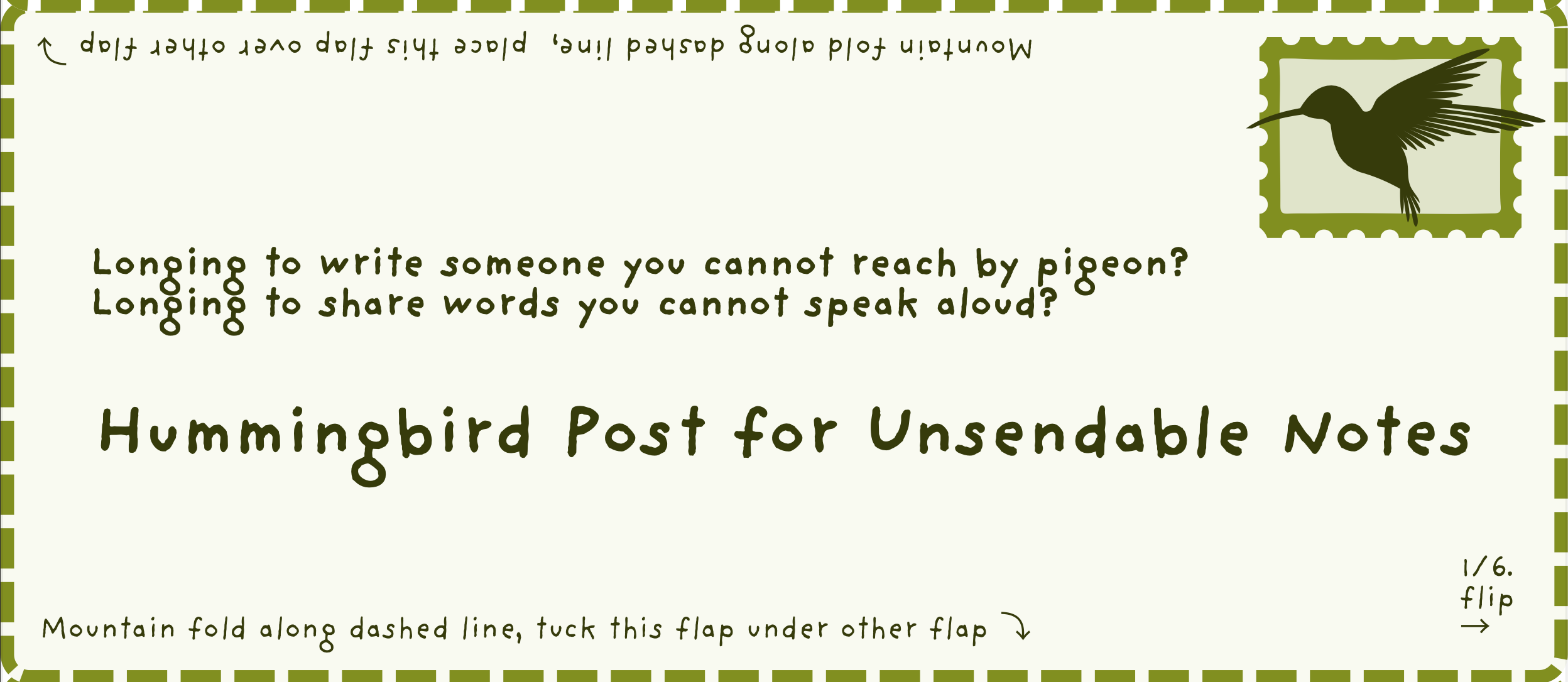
 Excerpts from participant Larkin’s final project, titled “Hummingbird Post for Unsendable Notes.” You can engage with the work here: https://neurodivine.itch.io/unsendable-mail. A screenshot of the front of an envelope, outlined with a dotted green border, with a stamp depicting the silhouette of a hummingbird in the top right corner. In the center, there is the following text: “Longing to write someone you cannot reach by pigeon? Longing to share words you cannot speak aloud? Hummingbird Post for Unsendable Notes”. Around the edges, there are folding instructions.
 C: Yeah, yeah, yeah! We had a lot of nature too!
L: Especially for the final project, like there were a few, yeah, what you were saying about like almost like memory and like longing. We had a really lovely and funny project about wishes and, like, the format of almost, like, you know, the- what is the specific name? The really sad animal adoption advertisements.
C: Oh, the, like, “In the arms of an angel” commercials?
L: Yes! Exactly. Yeah, someone essentially did a pitch with that song playing about all of these lost wishes that want to be adopted.
C: That's really tight; I love that.
L: We had some things about caterpillars and butterflies and that experience of transformation. We also had a really powerful website about the loss of a pet. Yeah, I think maybe also the final project happening as winter turns into spring has some influence. Like “Okay, we're we're we're with the trees, we're with the plants, that's the vibe.”
 An excerpt from participant Jessica’s final project, titled “Society for the Protection of Shadows Adrift: Wishing Well Walk.” A digital rendering of an open manila file folder with “Wishing Wells” handwritten on the folder tab. On the left, there are three pennies and four Polaroid images of wishing wells, one of which has a rainbow sheen. On the right, there is a paper titled “Wishing Well Project Proposal Background Information”.
C: Speaking of trees, we had a really sick one from this student Mari. She made one that was like a tree dating app made in Twine, where you’re given all these different trees and you're like clicking through and trying to ‘match’ with them- and they're like real trees in New York City with like addresses and shit that you can go to! And all the trees profiles were all written in like tree vernacular, but also like sexy tree vernacular. It was so good.
L: Oh my gosh, whoa, that's so fun.
C: Do you feel like you’re leaving this session with any takeaways?
L: Let's see…I mean general takeaways from every time I engage with this sort of material is just, I mean this was the title of my blog post last year, but there are stories everywhere. Like that is really just always the energy of like, oh my gosh, I can just be, sitting at my desk looking out at the world and after being in this class, like 10 different ideas of ways that I could now engage with it as a story appear. Not to go all the way there, but I do think there's just something so particular about drawing out the whimsy and the like hidden layers that are just like always kind of floating around and making them into something more cohesive for yourself or for other people to notice.
C: Yeah, yeah, I think that's a really beautiful way to put it. Earlier this year, right before class started, I went to the library, and I just checked out a bunch of poetry books because I wanted to expand the way that I was thinking about storytelling and language and just bring a bit more experimentation into the work. I think this class was really sort of generative in that way of thinking of just how expansive a story can be, how expansive language can be. Like, you know, like you said, there's poetry in everything, there's language in everything, and everything can also be like a site for play too.
C: One of our students did a project like an RPG around just waiting for the train, and I think that shows you can take the most mundane aspects of your daily routine and create something beautiful from it. And yeah, I think especially like in such a in such a fucking difficult time that we're in right now, like impossibly difficult, it's been a very good reminder.