
August 18, 2026 Winter 2026
With how drastically the technological landscape has changed over the past few decades, visiting a handmade website today can feel like an archaic experience. “Surfing the web” as the primary mode of being online has been fundamentally replaced by the endless doomscrolling of short form slop content on social media apps. Gone are the days when being online just meant opening up an Internet browser. For many, the act of wandering through hyperlinks, getting lost in rabbit holes, and feeling like you’ve discovered something new—without the influence of a personalized recommendation algorithm—is a relic of the past.
This winter, we gathered online for the third iteration of HTTPoetics, where, over seven weeks, we studied the poetics, aesthetics, and interactive nature of the web. From really big and labyrinthian sites to crude and ugly ones, we learned to make websites that break the mold of modern conventions in web design and development. Collectively, many of these experiments gravitated towards concepts that explore the relationship between memory and the web.
 Gracielle Camara’s iSpy World pays homage to the “I Spy” book series by reimagining it as an interactive, browser-based experience. Evoking nostalgic childhood CD-ROM games, visitors move through the page to locate various objects and trinkets with their cursor-flashlight.
 AJ Toure’s iophilia is a meditation on caves, the dark, and the Earth. The site, which uses collage as a navigational tool, invites visitors to get lost deep within a series of cave scenes, with each pathway unlocking a textured combination of interactive objects, sounds, poetry, and more.
Making a website by hand is a slow and deliberate practice that often involves painstaking amounts of testing, debugging, and refining. In today’s era of generative A.I. omnipotence and the gradual decay of the “old internet,” it is an act of love that goes against the grain... much like keeping a memory alive in a world that quickly moves on.
Visiting artist Jackie Liu, who considers technological nostalgia as a site for artistic intervention, believes that the process of struggling through things and moving through discomfort during the creative process is how we learn and let ourselves be changed. She states, “it is courageous to be devoted to the creation of making something, it means you believe in it... and everything I bring into this world is something I want to believe in.”
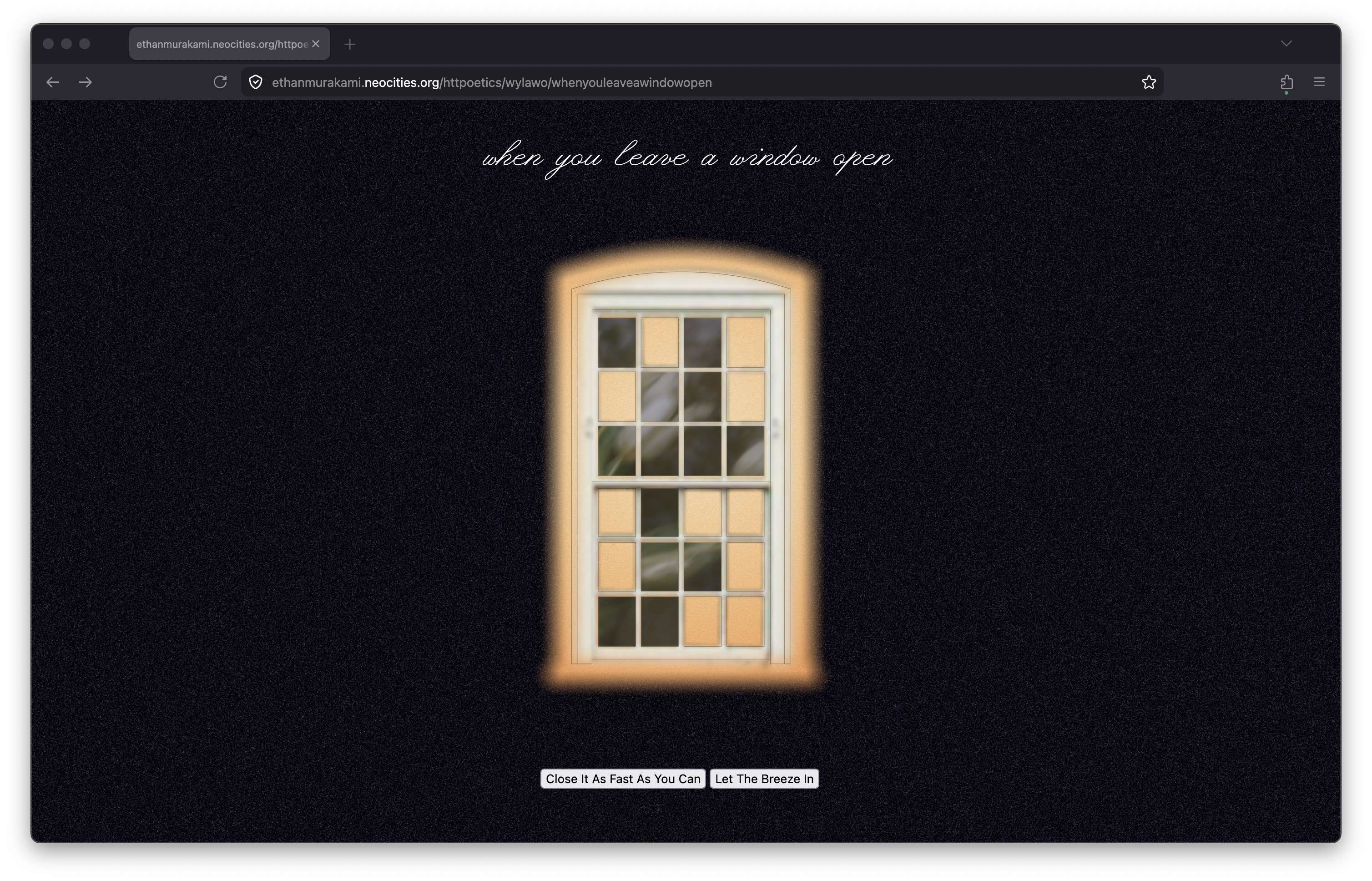
 when you leave a window open by Ethan Murakami is a narrative journey about feeling trapped within a toxic relationship recounted through custom buttons, dialog boxes, and pop-up windows. To unfold the entire piece, a visitor must repeatedly make the “choice” of inaction as windows continue to open, looping and cycling through trauma until the visitor finally decides to close the windows.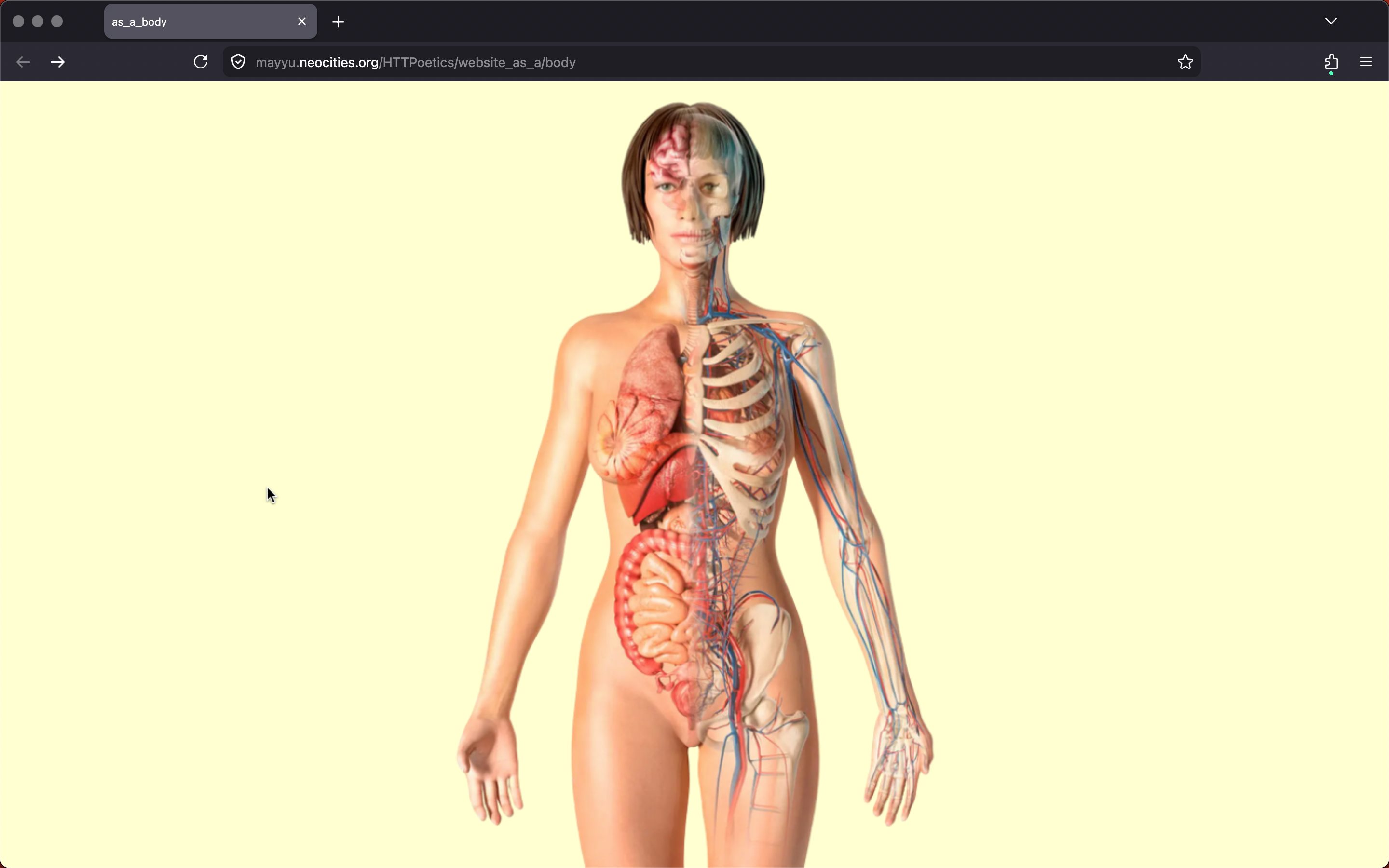
 as_a_body by May Yu references human anatomy to allocate a series of personal writings that explore dreams, desire, grief, and regret. Each body part holds a poem driven by a corresponding sensation or function (in the lungs, holding and releasing a click depicts the act of breathing words* in and out; the brain carries a slew of text that is only made legible through careful inspection of the page’s internal contents).
During one of our classes, we asked our students to consider how a website might embody the physical objects and spaces we encounter in our everyday lives. Inspired by readings such as My website is a shifting house next to a river of knowledge. What could yours be? by Laurel Schwulst, we considered the infinite possibilities of what a website could be, and studied how navigating our websites might mirror the way we naturally move through physical spaces—sometimes with uncertainty or curiosity.
 In ham.mam by Azad Namazie, visitors are welcomed into a hammam, or bathhouse. Each room within the hammam opens a unique ritual and treatment for the visitor, as they bathe, massage, and cleanse themselves from grief, rage, betrayal, alienation, and bewitchment.
 Samiha Alam’s do not stop the car interprets a website as a transitory space, like an elevator or airplane. The site carries a sequence of memory containers—each accompanied by atmospheric, dream-like, royalty-free music—that open up seamlessly from one to the next as a visitor journeys between them.
The saying goes that once you put something online, it remains there forever. Yet, websites are inherently fragile if left alone. Knowing that a website exists today is no promise that it will be there a year from now—as domain name licenses expire, hosting platforms shut down, and code dependencies become deprecated. To preserve (and remember) a website requires perennial attention and maintenance.
Visiting artist Chia Amisola views sitemaking as both a practice and a form of resistance. They remind us that “people have always found themselves on the Internet, despite how hostile it can be.” For Chia, websites are structures of self-preservation, serving as personal archives for accumulating our often fragmented selves.
Many of the websites from this class are interactive poems that navigate nostalgia, grief, and healing. As we long for a past we can’t return to, the web provides a space of exploration and reflection for us to process it. When we lose something precious to us, the web lets us memorialize it. After all, a site we create is a place we can always come back to—so long as we are the ones building it, mending it, and keeping it alive. Will we tend to our sites as we tend to ourselves?
The HTTPoetics Anthology 2026 can be found here.