
July 17, 2026
Editor’s Note: The following transcript documents a keynote delivered by Kelli Anderson at School for Poetic Computation’s Poetic Promenade graduation ceremony, held on June 21, 2026, at Roulette in Brooklyn, New York.
This transcript has been lightly edited for clarity, readability, and formatting while preserving the spirit, tone, and substance of the original remarks. Minor adjustments include correcting transcription errors, removing verbal repetitions and filler language, and standardizing punctuation.
Listen to and watch her presentation on Vimeo.
Today is a day of celebration, but one, of course, that's against this backdrop of a recent history that is so heartbreaking in so many ways. What I've decided to do with that is to bring a little bit of a School for Poetic Computation time capsule to the forefront. So let's go back to 2018, when I first got roped into SFPC.
It started when Zach Lieberman emailed me in January 2018 about shaping a new craft track at the school, and it ended up being me, Robby Kraft, and Pam Liou. As you can see, out of all of us, I'm the one who has no chill. So, rightfully, no one even dignified this email with a response. I looked at it and thought: that's the end of the conversation.
 Kelli’s e-mail about the new track.
But in my defense, I had just put out a book called This Book Is a Planetarium, which takes tech objects and reduces them down to their bare paper minimum. I was really interested in thinking about how much human beings actually need friction, function that your eyes can follow, and how those things keep us oriented in this world, connected back to the material world, to our bodies and the limited resources of this planet. So I was already riled up and ready to go, and everyone tolerated me with grace.
We loosely agreed to build a curriculum for computer people centered around the hand as the fundamental, foundational tool for thinking and producing function. The three of us convened at the Dark Matter Manufacturing on Flatbush Avenue, circa 2018, and invented a new curriculum called Crafting Material Logic, based on the idea that to know the world, one must first construct it. We were pretty much kids in a candy shop, we were like, oh we can have Volvelles, we can have cryptography, we can watch the way things go, and on and on. We'd talk about Jacquard looms, how we got to the moon, algorithms and paper. You name it, it's in there. So we were obviously very excited. This would be a class taught at Westbeth, and we were stoked. This is us. This is an actual photo:
Robby Kraft: Computational Origami
The first teacher was Robby Kraft, who taught everyone about computational origami. He used origami as a jumping-off point to a larger question: what are numbers, really? Baked into the mechanics of this ancient craft practice is a totally alternate universe of relating to quantification.
I offer this up to the graduates: if you ever need to, try to look at your lens through your ancestors, through ancient craft practices, to see things differently. If I ask you to find the center of a piece of paper, the normal plan of attack is to translate the dimensions of the paper into an abstract quantity, divide it by two, and end up with another abstract quantity you then have to measure. But in origami, the plan of attack is to take the piece of paper and fold it in half, and that's the center.
 Paper manipulated into an interesting shape through Origami
That was a profound jumping-off point for thinking about what makes data, information, and numbers feel more inherently human. How can we make it a more fleshy way of navigating quantity? As humans, we think through our bodies far more than we realize. Our nervous systems aren't isolated, floating brains above our heads, the nervous system extends all the way to the skin. There's a quote: everything is felt on the skin. If you're reading something, that's light photons hitting your retina. If you're listening to me talk right now, that's wobbly air hitting your eardrum. It's profound that this fleshy turnstile is how all information passes into our consciousness.
To keep riffing on Robby's thought experiment: what is a circle? Is it a math problem (any point equidistant to a central point) or is it a gesture? One of the oldest circles ever made by man wasn't produced through industrial engineering or mathematics, but through a gesture. Take a small hard stone and rotate it into a larger, softer rock. It digs in, establishes a fixed axis point, and scrapes away material at a fixed distance from the center. The only shape that can result from that gesture is a perfect circle — equidistant points from the center, achieved through motion rather than measurement.
In the modern world, a gestural or dance-based mathematics isn't something you'd find at a university, but you might find it at the School for Poetic Computation. Robby's point was that there are always two inroads to quantity. He directed his class to create algorithms using paper folding, referencing the work of Erik Domaine. One student, Sukanya, made an amazing dancing origami torso that floated around at the show.
Pam Liou: Weaving and Binary Logic
Another teacher was the lovely Pam Liou, who led a binary-core friendship bracelet workshop. Pam had just invented a computational loom called Doti, and was interested in how a material's specific affordances shape what kinds of logic systems it can support. What is your material like — does it fold, does it bend? How do those affordances shape what we can make, and is this a lens for examining the history of technology?
Pam's work started with fibers. She was particularly interested in how the affordances of fiber have shaped technology: the khipu, the data-tracking system of debts, rows, and columns used by the ancient Incans. She blew our minds by introducing binary-core systems: coordination systems built through a labor-intensive weaving process. Space-age needleworkers, recently laid off from a local textile mill, were employed by NASA to weave memory modules, incredibly stable structures that stored the maneuvering coordinates critical to guiding the Apollo mission to the moon and back. They used grids of magnet wire as threads for both the warp and weft, then placed a ferrite bead at each crossing.
 A woman weaving memory modules at the Raythean plant in suburban Boston.
That's what the class made. There aren't actually coordinates to the moon embedded in their friendship bracelets, but some students' binary-core messages held secret messages to each other, which was pretty cool.
 Friendship bracelets made during Pam Liou’s workshop.
Kelli’s Group: Craft and Material Logic
We transitioned to my group by discussing how the Victorian public's insatiable appetite for ever-changing patterns of Jacquard ribbon precipitated the invention that separated a machine's material from its choreography, or programming. That was the beginning of the computer program. In Jacquard looms, patterns were controlled by punch cards. Want a different pattern, unhappy with little flowers, want little hearts instead? You change out the cards. That development led to modern computing. Before then, if you wanted a different shape or pattern, you had to build a different machine, like a bagel former, which only makes bagels. The shape is hard-baked into the machine.
 The precursors of punch cards seen in a Jacquard loom
In my class, I was interested in going back to the time when material and programming were united as one. What particularly interests me, all of my favorite things, are things that seem like magic but have no hidden parts: a function your eyes can follow, because I think the best objects to think with are the best cognitive partners. Like an automata drawing machine: we shaped different discs for the x, y, and z coordinates to make different drawings, like a little peace-sign hand.
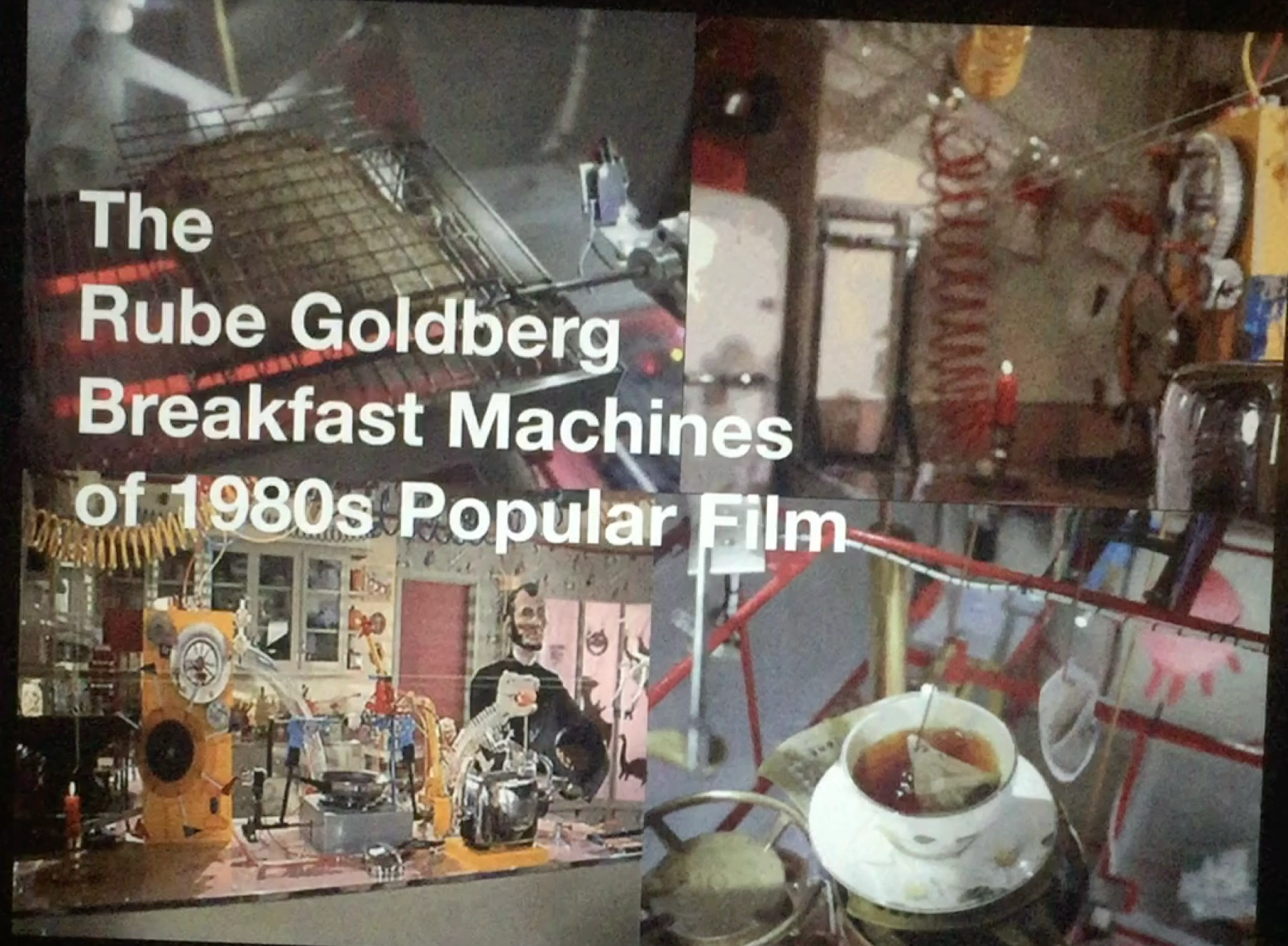
We talked a lot about the Rube Goldberg Breakfast Machines from 1980s Popular Film: you wake up, hit the alarm, somehow there's a wire attached to it that goes to your kitchen, a marble rolls, hits something else, something else spins, a fan comes on, and suddenly you have pancakes and eggs. It's amazing.
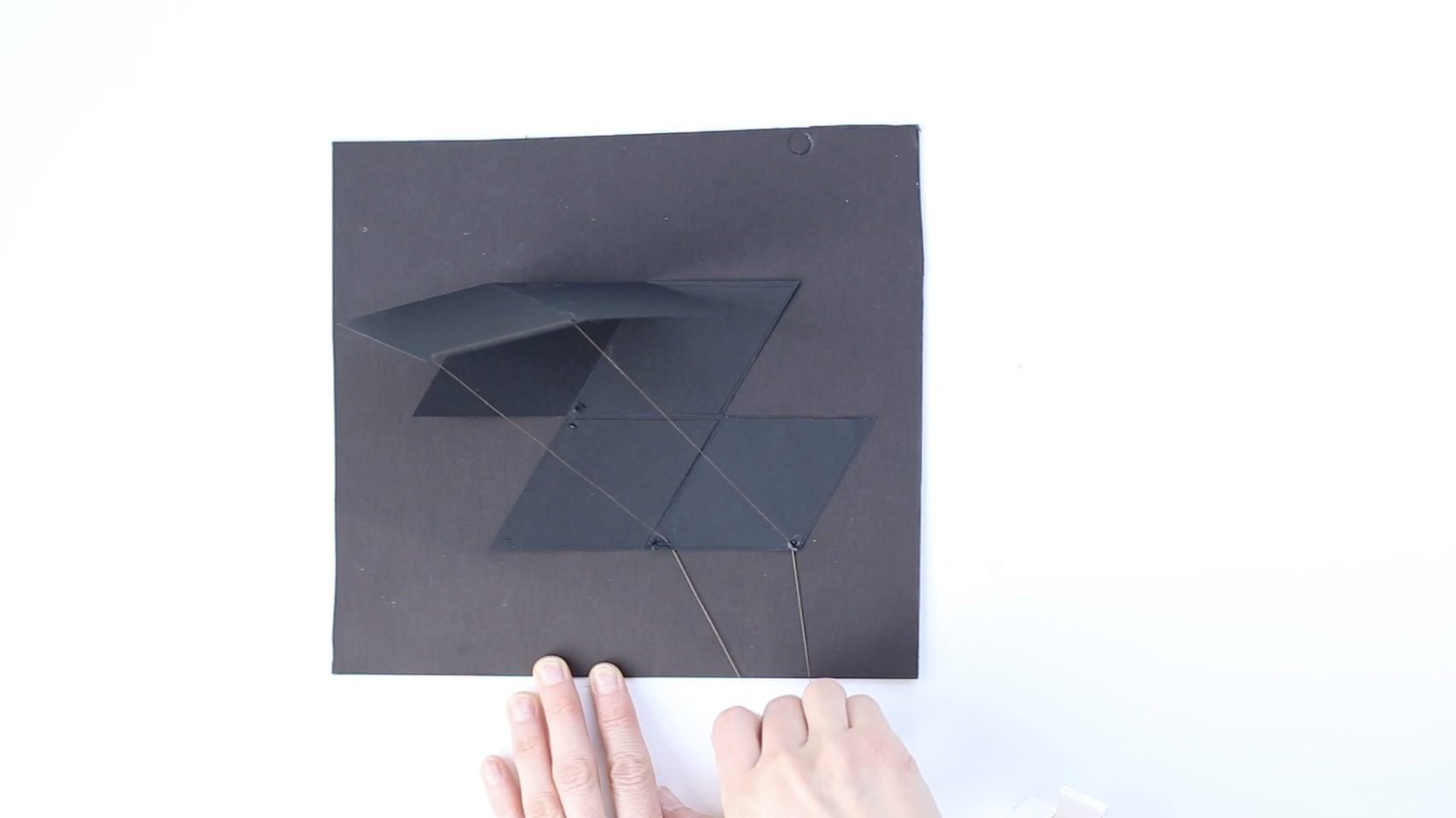
We also looked at and made a lot of pinhole cameras: cameras where the aesthetic outcome is directly created by the structure of the camera itself. One had funny little cuts in it, producing a distinctive photographic outcome. These are examples from Peter Olpe's book; he's made hundreds of cameras. There's no Photoshop or image editing, just a funny-shaped camera that will warp the image in its own way.
 Page from Peter Olpe’s book “Instructions for the Construction of Pinhole Cameras and Lens Cameras”
The students really ran with the idea of investigating how we program materials, how we program a drawing, and how it feels to make generative, conditional drawings; to become aware of what is missing, and whether that's liberating; what it feels like to resist the normal mechanics of craft and tinkering. One drawing was a three-player game: player one set dots in certain places, player two couldn't cross their lines in a specific way. A system that generates specific outcomes with a bit of flexibility.
 Three-player dot setting game
We ran experiments with our attention, paying close attention to patterns that recur in the city, and turned them into little flowcharts that directed our classmates. Every time you saw a brick, stepped on a crack, or passed a stranger, it generated a musical score, a dance routine, or some weird athletic ritual like jumping from concrete structure to concrete structure.
We asked all of our students to bring in some material and show us how to program it. My recommendation and advice to new graduates: may your future project never depend on nitinol wire actually behaving as advertised.
This all culminated in bliss and utter anarchy in the classroom. Things were getting lit on fire; it was a wild time. The class, with all three teachers, culminated in a frantic build session I like to call kindergarten grad school: we went to Home Depot, got trash boxes and dumped them on the table, and said, "Recreate some kind of computational process or function using this cardboard. You have three hours." We got some logic gates out of it: a NAND gate monster, an amazing sine-wave generator, a duplication machine (during which we further destroyed SFPC's floors). And a system for making RGB pixels and shining a light through them with your phone to project onto the wall.
 Nitcha Fame’s NAND gate monster
That was a very joyful, fast-paced time, and I'm grateful to SFPC for giving me the opportunity to work with all these brilliant people.
Why Craft?
So where this talk is going is: why craft? Why bring cardboard, paper, and craft materials to people who are mostly thinking about working on computers? We were mostly playing with markers and plastic, making functional things your eyes can follow. I like to tell my students that the flimsier the interface, the less of a barrier there is between you and the forces you're interacting with. If a problem seems hard to manage, try to translate it into something easier. That's some of my graduation advice: make the interface flimsier.
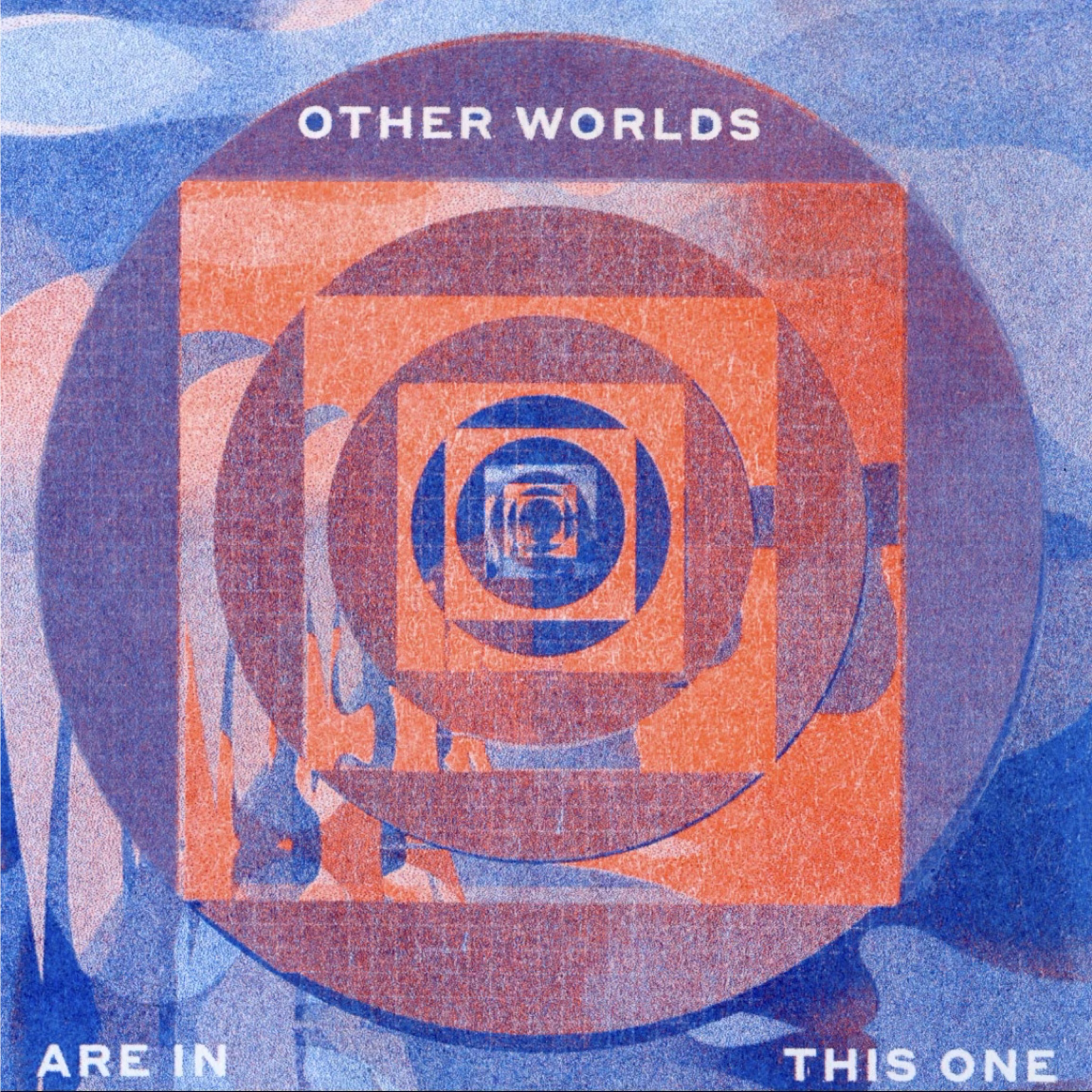
I think the answer lies in something the poet Paul Éluard, one of the founders of the Surrealist movement in France, once wrote: there is another world, but it's in this one. Many people insist you can only get to another world with the highest-tech equipment. I'm here to tell you: those of us who make art, who cook, who craft, who have tended to the life of a plant, a pet, a child, those of us who have mastered small things are correct in knowing that you can also tunnel inward. Another world lies down the barrel of a microscope too, and we get to it through our senses, which are much smarter than we imagine. We're always gathering information on channels we're often unaware of: how a glimpse came in through our fingers, seeped through our skin.
This extends beyond physical craft. You can have a spidey sense about code too. Sam Anderson wrote that a quality of all real windows is that they frame our fundamental lack of control, and craft is something that extends our brains to things far outside our control. It's a process that doesn't care what you want. It's not an algorithm tailored to your wish fulfillment; it won't pat your back when nothing works the way you want. But it's real, and it's a layer on top undergirded by a vastness none of us will ever fully understand. It operates in short feedback loops: you tinker with, or fight with, something, and that thing becomes a cognitive partner, an extension of your own brain out into the oxygen and daylight of the real world. The quality of a cognitive partner lies in how well it supports you, how readily it empowers, collaborates with, and extends your own superpowers of human sensory intuition. I think that should be the goal of everything we make — all technology. That's the utopia I want.
The opposite are mechanisms impervious to our senses, that intentionally alienate us from ourselves and our intuitions, mechanisms intended to keep us trapped as passive consumers. Byung-Chul Han writes passionately about this in a short, interesting book called Non-Things, which I'd recommend. But I'm keeping this celebratory for the graduates, so I won't get too dark today, that one's good to read later.
Craft, as a modality of thought, is inherently radical. I want to share a small clip from one of the most incredible living artists, Julie Mehretu, and her recent commencement speech at RISD, where she talks about the intuition of the hand:
"Where the hand seems to know something the conscious mind does not. Where decisions get made visually, intuitively, pulling from everything you have ever seen and studied and felt, and also from something that feels like it comes from nowhere, where chance enters and you follow it, where serendipity becomes a method. I want to be precise about what this is because it is built, not bestowed. Intuition is a developed sense, earned slowly through the discipline of paying attention, through constant curiosity about everything, the way the material talks back to you if you are willing to listen. This is a skill, one of the most demanding and important skills there is in creative work, and what it requires above all is patience and a genuine embrace of not knowing. Not knowing as an internal sense of possibility, rather than paralysis, the unresolved as a place where real work lives."That not-knowing, that uncertainty, that's where possibility comes from, and it's uncomfortable. Truly seeing things on your own terms means something radical. It means forgetting received names for things, received judgments, definitions, valences, what is good, what is bad, and working hard to discover the world on your own terms, presenting it back and sharing it with us, testing the bounds of tangible reality to figure out and become certain of what is true for yourself.
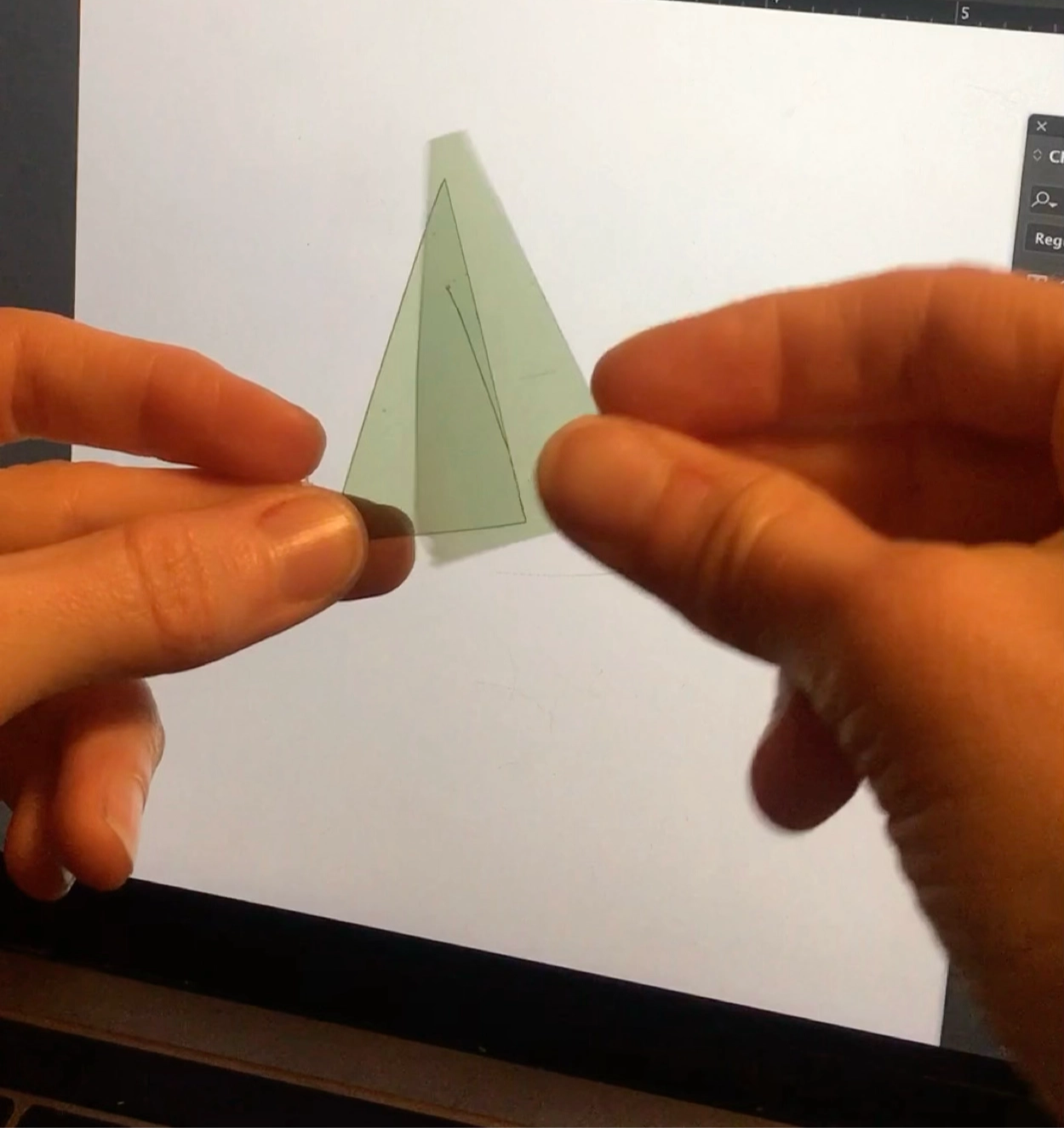
This is the most fundamental way that free humans think, how babies think. AI can't do it. Only humans can think with the first hand, through their skin. And people who are empowered to trust the information coming in through their senses, the things they see with their own eyes, those people can call bullshit.
So, graduates: you've already trained your hands. You've worked hard. You've trained your eyes and your brains to figure this out. This method of thinking: what artists know, what you know, what you do when you work on your projects, how to question, how to test all kinds of assumptions before you accept them. I think that practice, what we do as makers and builders and artists, is the only way out of the crises we're currently in.
When you think critically through your own body, you can plainly see how the world in front of you is put together, how it's structured, how its machines and mechanisms work. You can see what David Graeber calls the ultimate hidden truth of the world: that it's something we make, and could just as easily be made differently.
So, to the graduates: don't be afraid. Don't waste time being afraid. Use that intuitive sensing, the most human part of yourself, as a detector for the world's unlikely and radical potential, because we need to flip the table soon. You have the tools. Trust your hands to lead you there, and we will all follow you.
A few final things: keep your wits about you. Keep one foot (or at least a tiny pinky finger) grounded in the material world, or at least in something that pushes back at you. Never let them separate you from your intuitions. And don't forget to have fun. It's the gas that makes all of our cars go.
Thank you all.