September 29, 2026 Spring 2026
In "Disturbing Code," which I taught last spring, we looked at projects that use recent digital tech to enact ideological or political protest—and disturb the status quo. From DDoS attacks, to data poisoning, DIY servers, radical archiving, today’s Luddite movement, protest robots, and more: code in this class both disturbs and, as a medium with imperialist roots, is disturbed. We borrowed our vocab from the Electronic Disturbance Theater to describe political action that takes unexpected forms, causes discomfort, and endures.
A class on political action has got to center action—so, much of our time was dedicated to supporting group projects that engage “disturbing code.”
We started with readings by Ricardo Dominguez, Audre Lorde, and Laboria Cuboniks—to help us think about how, when, and if masters’ tools can dismantle masters’ houses. What are the limitations and potentials of seizing tools that, like much new tech, were built for violence and oppression?
We then sunk ourselves into a massive collection of effective “disturbing code” projects, split into three categories:
- 1. “Correct Usage, Radical Ends” - Projects that employ existing digital tech for political action [Eg. organize.directory, Flockhopper, Ban the Scan, HK 19 Manual, Beautiful Trouble Toolbox, and Red Calendar]
- 2. “Direct Action (Blocking, Flooding, Poisoning)” - Projects that damage or sabotage existing digital tech—meddling with data, taking down websites, etc. [Eg. Electronic Disturbance Theater, Bail Bloc, AdNauseum, and SlowLLM]
- 3. “Divest and Rebuild” - Projects that build new digital tech and/or espouse total avoidance of existing digital tech [Eg. Tech Reclaimers, May First, NYC Mesh, Cache Me Outside, Solar Protocol, and Dinkins’ Not the Only One]
Students then sprung (!) from this bed of inspiration into their group projects. After being assigned to skillset-diverse groups or “cells,” students were provided collaboration guidelines and offered ample space for class feedback. The resulting group projects (meant to be at the performance or prototype stage) were badass, including:
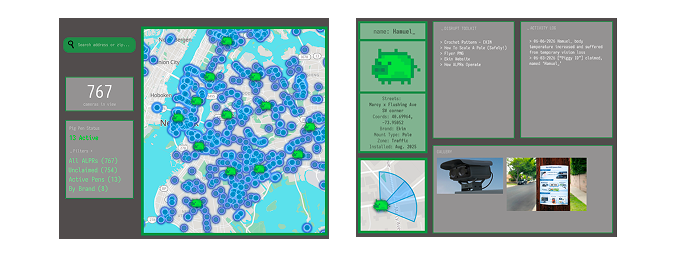
- Pigs in a Blanket: a website that gives general guidance (including crochet patterns, installation tips, and ALPR locations) on how to make ‘blankets’ that decorate and/or physically obstruct ALPRs.
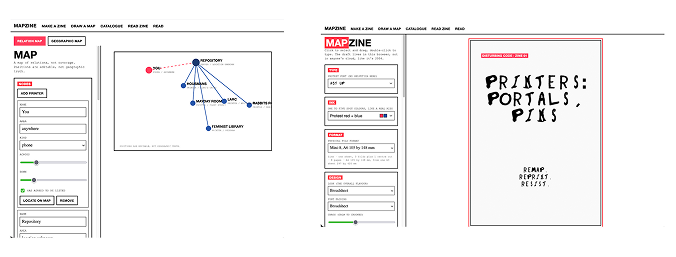
- Mapzine.press: a website for making and printing zines and community maps, treating distribution as direct action, anonymity as a design right, and the community that uses it as the only authority over its content.
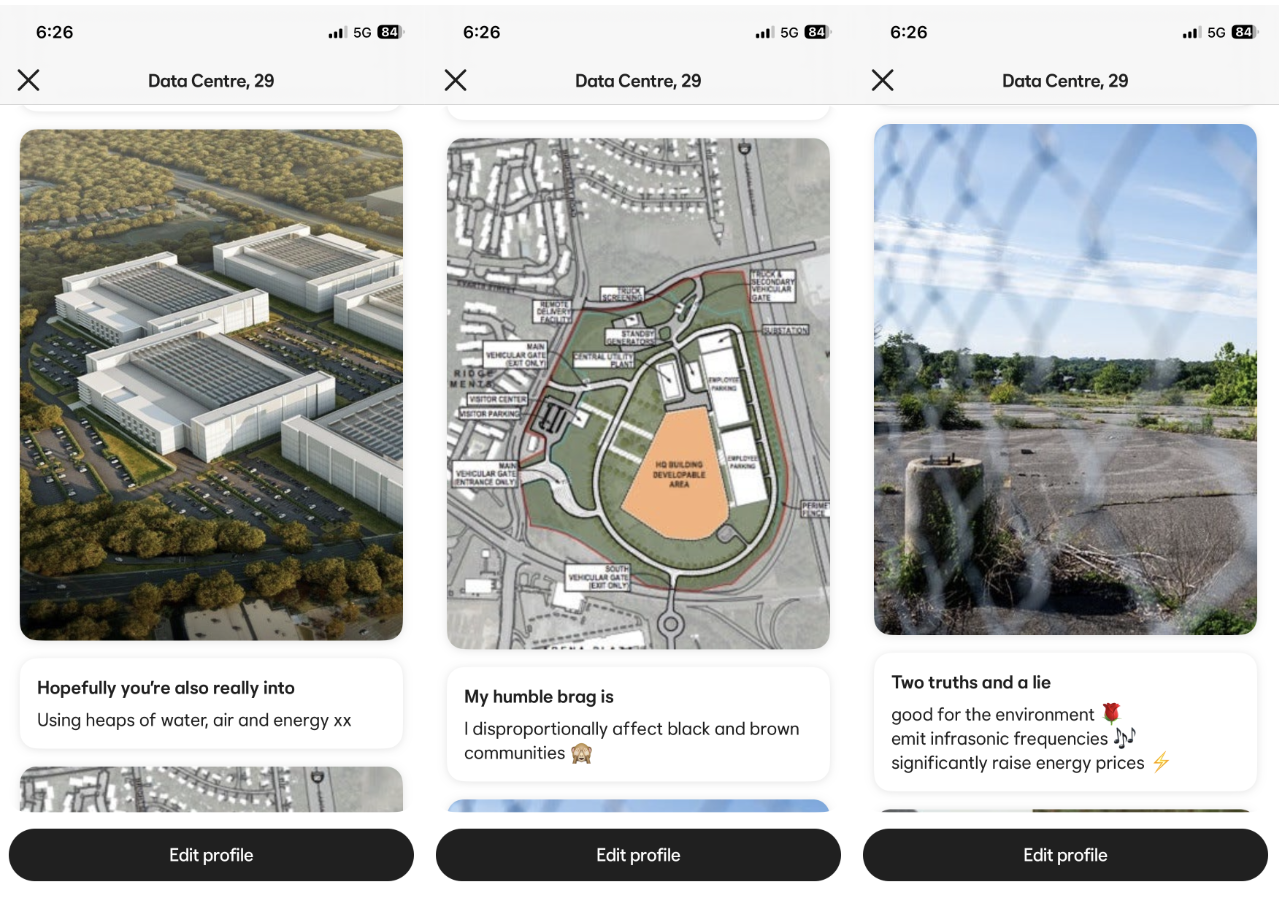
- Flood Hinge: A project that flooded Hinge and Google Maps with information about data centers’ impact on local communities.
- Clockwork: A browser extension that calculates (with some accuracy) how much money you have raised for Meta based on your activity on Instagram, using the visual and verbal language of fundraising.
As more and more modes of protest are being criminalized in the U.S., we took precautions to protect the anonymity of participants. All class communication took place on E2EE platforms, final projects were by default anonymous, and participants started the class by renaming themselves with a username.
Avoiding lecture, the course was always discussion—and collaboration-centered—and we learned by thinking and acting together. Some of my favorite questions from class discussion include:
- Who built the masters’ tools and who actually wields them with their hands? The workers! So were they ever the masters’ tools? (Luddites’ “Enoch built it”)
- When/where is technical language elitist/inaccessible? When/where are big words elitist/inaccessible? When/where is anger or manifesto-like confidence elitist/inaccessible? When/where is access meant to be limited, and why?
- What other forms of ancestral systems/technologies are available?
- Can we resist a purity mindset, and use tools while understanding them to be limited? Are some tools too deeply embedded in the power structures that bore them to ever be used (eg., big-tech-trained LLMs), or no?
- Can we think of these projects as brave experiments that help set a precedent for what might be possible on a larger scale?
- Where is the line between raising awareness and effecting meaningful change? To what degree is this question useful?
- Which of these works can be considered counter-offensives vs. appealing for rights?
- Is data always violent? (Violence of data collection, violence of data omission, violence of the abstraction/illusion inherent to data)
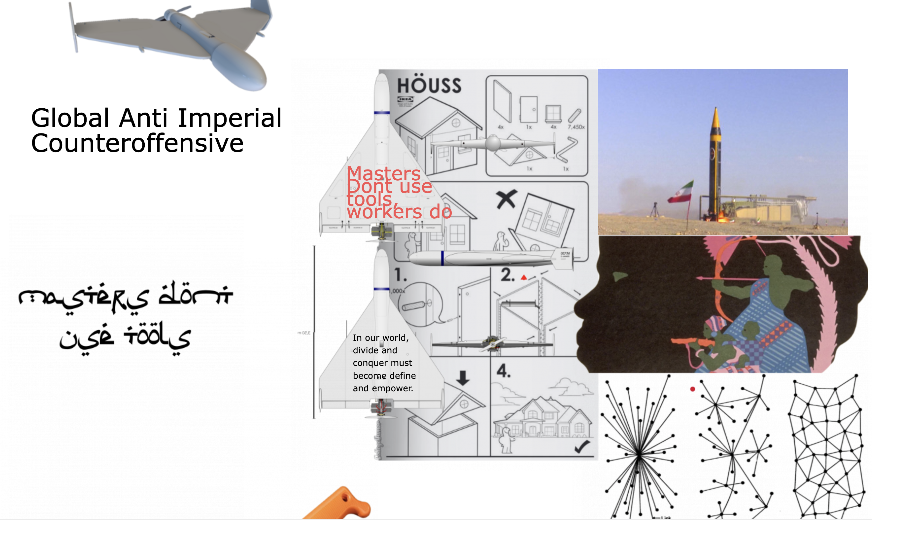
Throughout, participants kept a “Disturbance Scrapbook”: a net.artwork-cum-notebook that they updated every week. Built with Hotglue.me, neocities.org, or basic HTML/CSS, the "Disturbance Scrapbook" was visible to all participants and held anything they wanted to save from the class: images, links, quotes, notes, references, etc. In the penultimate class, each student was randomly assigned several other students’ Disturbance Scrapbooks to present. This allowed one last an opportunity to address new aspects of our themes, while providing a final mode of connecting with and learning from one another. Here are some screenshots from the Disturbance Scrapbooks: