March 5, 2026 Winter 2025
Solidarity Infrastructures is a class developed around the convergence of practice and praxis. From the e-mail list, to the syllabus, to the video platform, and class archive, the class runs on self/collective-hosted infrastructure from groups like MayFirst and Domaine Public.
The class demystifies technological infrastructures as a key pillar of retrieving our techno-agency. In our current state, technology both consumes us and dissociates us. Where does technology come from? Who owns it? How can it be used? What does it even... do? Moving through these questions plants seeds of hopeful conjurations and calisthenics for breaking free of big tech’s grip on our mind and habits.
Teachers have run Solidarity Infrastructures at School for Poetic Computation five times since 2023. Alice Yuan Zhang and Max Fowler initiated it; Mark Anthony Hernandez Montaghy, Oren Robinson, and I, Meghna Mahadevan, supported its growth. Alice has since departed; Max and I taught it with the support of Olivia Ross in Winter 2025, and then again in Fall 2025 with the support of io hushpuppie. Stewarding this class at this time feels like an important force toward divesting from empire and investing in alternative infrastructures.
Our work expands out from Ursula K. Le Guin’s declaration that "technology is the active human interface for the material world.” Le Guin meditates on how humans cope with the material world, and how technology can be used as the interface for that world we want to see. How are people housed, fed, and cared for? Are people getting their material needs met? Is the land being restored? How is technology used to manipulate material realities? How could it be used toward ecological harmony?
 llustration by Ven, Carly, Janey, Neuza in a digital collective drawing pad featuring people sliding through a Zipline.
My clearest desire for this class is that people walk away with renewed values around technology. Values that become tactical, changing how we engage with our technology, one another, and the earth. How do you build infrastructures of solidarity that depend on relationships, instead of the state as an intermediary?
As students and teachers, the most sacred hosting platform is our relationships. We create new hopeful norms of being.
 Excerpt from my introduction to the classroom: Let's practice being together / We cannot do every(any)thing alone
This season of class was filled with potent projects that impressed me:
- Ema wrapped her Raspberry Pi in latex and hosted on it a history of how sex work built the internet.
- Cookie turned an Ethernet cable into a synth.
- Ven built duuump.site with a collaborator —a submission based repository of deleted media.
- Arvin developed a map tracking right wing attacks in Germany.
- Dean hosted a message board and shared infrastructure at Riis Beach in NY.
- Gaby created a process for digital divination.
- June collected a private archive of trans stories.
- Yazmarr made a portal for undocumented children to access technical support.
- Geo revived an old Macbook to host sensitive community data.
- June and Max began Gateway coop, creating shared tunneling infrastructure for future projects, so servers have a cooperative workaround to port forwarding.
These projects act as new techno-routines and pathways for moving our bodies, data, and relationships in opposition to how tech giants systematically try to capture us. These conscious ways of moving generate our autonomy in refusing protocols assigned by algorithms, which I find to be sincere methods to dismantle global empire.
Students come from the United States, Canada, India, China, Malaysia, Western Europe, Mexico, and more, attracted to some aspect of the class description. Some experience police violence; proximity to genocide; are working class or rich;and some engage these topics online or through reading. What is it to hold an international, interclass, inter-identity, and intersectional classroom?
Increasingly, people shy away from complicated political conversations. We fight through clouds of propagandized media to decipher what is happening, what we actually believe. Writing people off as too problematic, too privileged, or too leftist becomes low-hanging fruit for rebuttal and avoidance; meanwhile, our listening muscles atrophy.
I encourage disciplined friction in class as the fertilizer for generative learning. These moments of conflict, where things break down, are the most magical moments. The classroom becomes a container for real conversations. I reflect on one such conversation, where I received feedback that I spoke in an American-centric way-- using a broad name for interlocking systems of oppression, what I referred to as “the state” and positioning “us” as people in solidarity “against the state.”
My sweet friend, Banah el Ghadbanah, tells me that bell hooks specified a phrase when speaking of the state, naming it “imperialist white supremacist capitalist patriarchy.” A mouthful, but clear. I don’t want to conflate systems of oppression when I use the term “the state,” and instead echo hooks’ urge for us to clearly call the system what it is and where its impacts lay--global imperialist white supremacist capitalist patriarchy, not exclusive to the U.S., but certainly stemming from hegemony of the U.S, global north, and colonial empire.
Within the U.S, we are not exempt from the impacts of global imperialist white supremacist capitalist patriarchy- from ICE raids to omnipresent surveillance to police violence to lack of access to healthcare to institutionalized racism and more, impacting Black, trans, disabled, poor communities the most. Simultaneously, we witness massacres of protesters in Iran at the hands of the government, obfuscated by a state-led internet blackout. Systems of global imperialist white supremacist capitalist patriarchy take on different and specific localized harms everywhere, yet we can all also be unified in what we are rejecting.
I called a dear comrade, Miliaku Nwabueze, and debriefed the feedback that my vague usage of the “state” in class could be problematic. She asked me, “What is your personal stake in state infrastructure? How do we build with someone who has a different relationship to harm and state violence?”
 Illustration by Dawn, Miriam, Priya, Tara in a drawing pad featuring a beehive and a solar panel, with notes proposing using gardens as natural routers.
The world is deeply interconnected, but what is our connection? We see the globalization of privatized surveillance technology, weapons manufacturing, and internet infrastructure such as Pegasus and Clearview AI, Palantir and Elbit Systems, Amazon and Starlink without oversight. This impacts all of us, but everyone has different proximity to the violence of global imperialist white supremacist capitalist patriarchy. Our race, class, gender, citizenship, ability, and more shape this proximity. The proximity often shapes our politics, which shapes our habits, consumption, and relationships…. And therein, with what and whom we are in solidarity. Am I open to seeing the connections between our struggles, even if it transforms what I believed was true? What convenience am I willing to sacrifice for the restoration of my siblings’ land and safety? What forges true global solidarity against imperialist white supremacist capitalist patriarchy?
June Jordan proclaimed, "I was born a Black woman. and now. I am become a Palestinian." A bisexual Black woman, she wrote these words in her poem “Moving Towards Home” as she bore witness poetically to the massacres of Sabra and Shatila in the 1980’s. Her listening praxis transformed her politics and the world, as it brought her “closer” to the Palestinian cause because she recognized its oppression intertwined with the oppression she faced without casting them in equivalence.
We are watching as the U.S. encroaches on Venezuela, bombing Nigeria, Somalia, Yemen, Iraq, Iran and Syria (Al Jazeera). The U.S. funded Zionist genocide in Palestine continues. We can trade comfort for global solidarity, listen and uplift the working people’s demands, nurture an embodied understanding of how our liberation is intertwined. Each time I bear sincere witness to you, I destroy the distance between you and I, and in this destruction I can find solidarity.
I have no perfect answer to how Solidarity Infrastructures can topple empire, but I do have a deep commitment to standing with all oppressed people, restoring the land, and using my resources towards the fall of empire. I see the key infrastructure of global solidarity to be our relationships between one another and the earth.
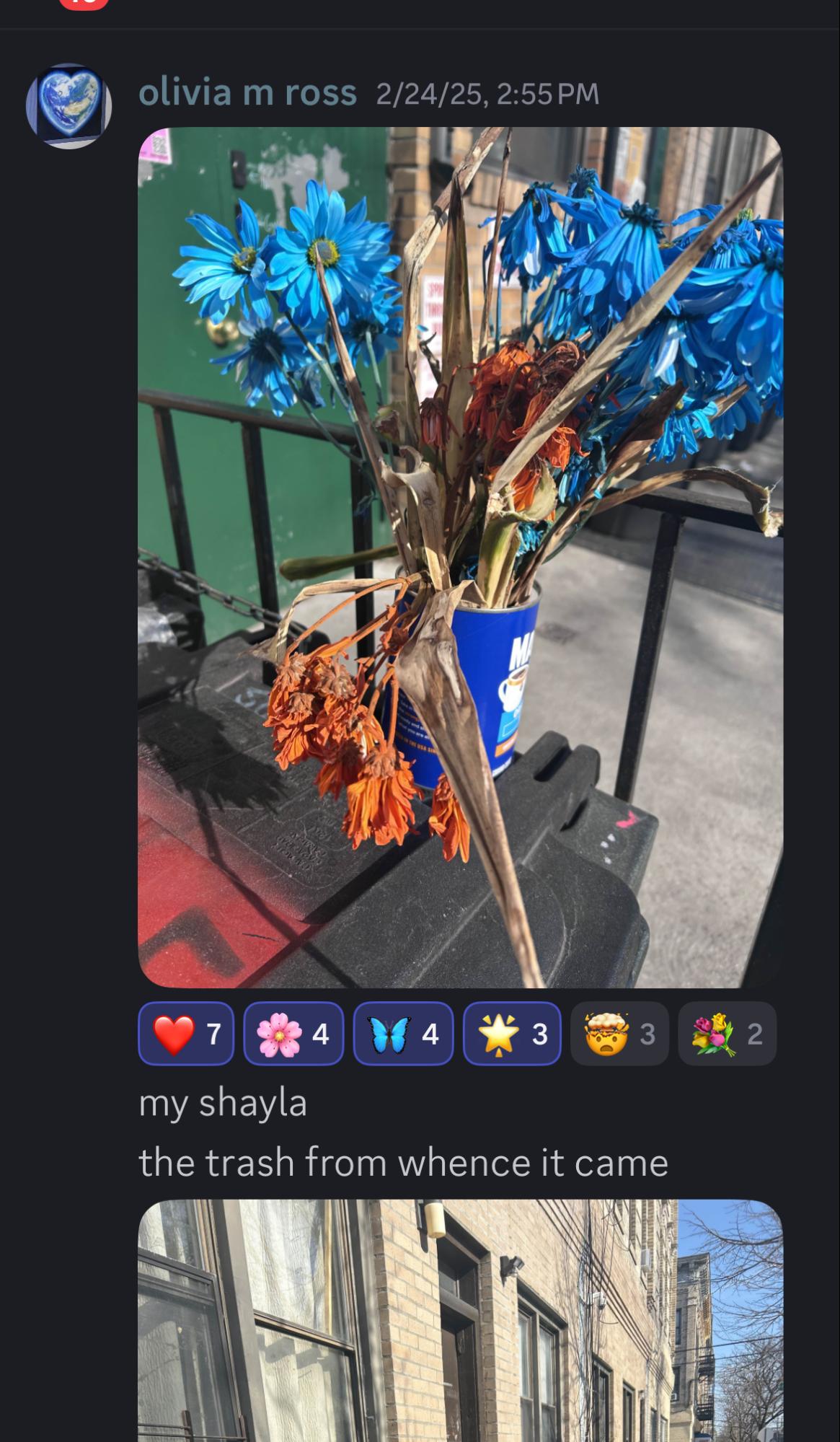
Dumpster Diving with Olivia
In closing, I'll share this audio piece. One class, our video conferencing platform, Big Blue Button, was down so we were audio-only. We were discussing the DIT (Do It Together) concept. Olivia made an impromptu shift from her lecture to sharing audio of her dumpster diving for electronic reuse (silly editing and ad-lib sounds by yours truly). Olivia shows us how creatively moving our bodies and visiting our relationship to consumption in our local environments can be a daily confrontation of empire and reconnection with the earth. These are the muscles essential to community autonomy, solidarity, and love.